.png)
People scroll less and less through the open web and increasingly stay inside their AI assistant environment. They ask a full question, get a tidy answer, maybe refine it once, and often decide from there. Search engines still matter, but a big share of “search‑like” behaviour is now happening through this assistant layer on top.
Recent research shows how big this has become: AI assistants now account for about 56% of global search engine volume and generate roughly 45 billion sessions every month worldwide. In the U.S. alone, they handle around 5.4 billion sessions per month, which is roughly one‑third of search engine volume there. Most of this happens on phones, not desktops: about 83% of global AI assistant activity and 75% in the U.S. is via mobile apps.

How behaviour is shifting
People aren’t abandoning search; they’re just doing more of the thinking elsewhere. Instead of punching in short keywords like “CRM tool,” they write what they actually mean: “What’s a simple CRM for a 5–10 person agency that lives in Slack?” They don’t feel like opening ten tabs and comparing; they’d rather have one good summary and maybe one follow‑up.
The study behind these numbers looked at the largest AI assistants and compared their activity to the biggest search engines worldwide. When you only count “search‑style” prompts—questions that look like traditional queries—AI assistants equal about 28% of global search and 17% of U.S. search. So this isn’t replacing search, but it is a serious parallel channel that quietly sits next to it.
How people now find vendors
In the classic SEO world, the path is familiar: search, see a list of links, scan a few titles, open some tabs, and eventually land on you if you rank well enough. Your site is where the story gets told: the blog posts, the feature pages, the case studies, the pricing tables.
In the AI‑assistant world, a lot of that story gets told before they ever reach you. Someone asks a question, the assistant replies with a short explanation, and mentions a small handful of vendors or tools. Those names instantly become the short list. If you’re not in that answer, you’re effectively not in the consideration set, even though classic search is still serving many more queries overall.
So the competition shifts from “Can we win the click on this results page?” to “Do we get named in the answer they actually read?”

What this means for winning companies
Because of this shift, “get more organic traffic” is no longer a complete strategy. The bigger goal becomes: for which specific situations do we want to be the default suggestion? You’re optimizing for inclusion in the answer, not just for visibility in a list.
That demands sharper positioning. You need to be very clear who you are for, what problem you solve, and what outcome you reliably deliver. Vague, generic messaging is hard for both humans and models to connect to a specific question. Concrete language, specific use cases and real numbers make it much easier for an assistant to say: “This one fits what you’re asking about.”
Content also has to change shape. It needs to read less like padded blog posts and more like clean, reusable answers. That means straightforward explanations, structured information about pricing and benefits, and case studies that spell out context and results. The more structured and consistent this is, the easier it is for any system to pull your brand into an answer at the right moment.
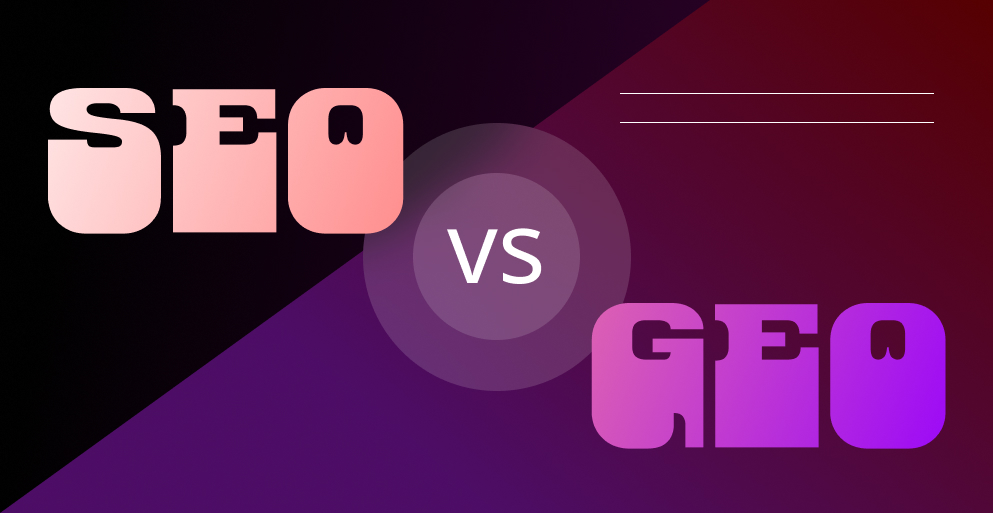
SEO vs GEO: the difference in one view
SEO is about ranking pages in search engines. GEO (Generative Engine Optimization) is about being referenced and recommended inside AI‑generated answers. They work on the same underlying web, but with different end goals.
With SEO, you focus on page structure, technical health, internal linking and backlinks so search engines show your site near the top. Success looks like rankings, impressions, organic sessions and click‑through rate. You win by catching the eye on a busy results page.
With GEO, you focus on how your brand appears as a fact in the wider ecosystem. You want consistent naming, clear product descriptions, structured data where possible, and public proof—reviews, ratings, case studies, third‑party coverage. Success is softer to track: more brand mentions inside answers, more buyers saying “you kept coming up when I asked tools about this,” and more direct signups where the first touch wasn’t a normal Google click.
They share the same foundations. Both reward honest, specific, well‑structured content. Both get a boost from strong reputation and third‑party validation. Both compound over time instead of overnight. In practice, your SEO work creates the raw material—good, indexable content and authority—that GEO can then reuse in answers.

What the numbers say
The current data makes the scale of this shift clear.
AI assistants now handle about 45 billion sessions per month globally, which equals roughly 56% of the volume search engines see worldwide. In the U.S., they process about 5.4 billion sessions every month and sit at around one‑third of search engine volume. When you narrow it to search‑like prompts, AI takes about 28% of global demand and 17% in the U.S. And most of this is happening on phones: 83% of global AI usage and 75% in the U.S. comes through mobile apps rather than browsers.
In other words: search is still huge, but there’s now a second, very real discovery track running alongside it—and that’s where SEO and GEO meet.
Where the opportunity is
The opportunity isn’t to declare search dead. It’s to be intentional about the questions you want to own. Instead of chasing visibility for every broad keyword, you focus on becoming the obvious answer for specific, high‑intent situations: a certain solution, industry, workflow or pain point.
You then shape your website, your examples and your stories around those situations in clear, factual language. You make your proof easy to find and reuse—public reviews, detailed case studies, simple comparison pages—so that when assistants and humans look around, they keep running into the same, consistent signal.
Put simply: SEO gets you discovered; GEO gets you chosen. Both matter. The brands that win the next few years will be the ones that quietly do both well.